Day Eleven: Glenveagh and Derry

Time for the longest continuous drive of this trip, from Westport to Londonderry. I woke up before my alarm, so I was ready, packed, and on the road by 6:30 am. The only stop that I had considered (but ruled out) on this drive was to hike Benbulbin, a distinctive plateau near Sligo. However, my calves were sore from yesterday and I decided that it probably wasn’t worth ruining the rest of my trip by overdoing it! I got to see Benbulbin from the road, and it was still very impressive.

Road photography of Benbulbin. Do not attempt—there was no one on the road.
The drive was relatively peaceful. I finished one audiobook and started another one, and the roads were easy and relatively free of other cars. This is exactly why I like getting on the road early. The driving is significantly less stressful.
I got to Glenveagh National Park around 10 am and got my bag situated to be outside for several hours. Glenveagh is a massive estate that had over 10k acres of forests and bog lands, a castle, several carefully cultivated “walks”, and a beautiful walled garden, and it was given to the Irish people by its former owner when he was no longer able to reside here, and it’s now one of Ireland’s National Parks. It’s enormous. The visitor center is a good 40 minute walk from the castle and gardens so there is a bus that goes from one to the other. However, it was a gorgeous day outside and I had been in a car for 3.5 hours, so I was definitely going to walk. Needed to work out some of the soreness from the Diamond Hill hike!
The walk was beautiful. It runs along the lake and has amazing views of the surrounding hills and bog lands and everywhere there was gorse blooming bright yellow. I know it’s invasive in the US, but it’s such a pretty shrub, even if it’s covered with thorns.

I genuinely don’t know why I’m so obsessed with this plant. But IT’S SO FLUFFY.
I made good time on the walk and entered the grounds through the gardens. All I could hear when I came through the gates was the buzzing of what sounded like thousands of bees. And I had never quite understood what someone meant when they said the air smelled sweet, but the garden smelled like a house that had been filled with lilies. It was wonderful.
I walked through the gardens and then into the walled garden, which was significantly smaller than the one at Kylemore, but everything was full of tiny details. Spirals of hedges, espaliered trees, carefully trained plant arches and little fountains so that you could always hear the sound of running water. On the other side of the walled garden there are so many different “walks”, small pathways that are arranged with a specific type of tree, or plants from a specific area of the world, or have a certain collection of art or buildings. It reminded me of Chatsworth, with all the little vignettes that the owners and brought back from their travels to remind them of places they loved to visit.
If I win the lottery I’m building a massive manor house and an enormous garden.
I wandered through a few of the paths and made my way back to the castle and walked through the house. Glenveagh Castle was built in the mid 1800s so it’s just built in the shape of a castle, but it’s reall a very elegant hunting lodge. It was still a home up until the late 50s, so it’s in very good condition and has a lot of modern upgrades that would make it still fully usable. This is a hunting lodge, but I did appreciate that the number of dead things was minimal, and instead it’s covered in hunting artwork, sculpture, and design. So. Many. Deer.
After walking through the garden and house (and all the way to the castle before that) I was a bit hungry, so I stopped at the tea room for a mini quiche (bacon and leek—I have to try making this combo) and a chocolate muffin, then I popped into the gift shop before deciding to take the shuttle bus back.
It was only about 12:30 pm and since check in wasn’t until 3 pm, I had plenty of time for my visit to Derry, so I started the hour long drive further north.
Okay, history time. Unlike the rest of this trip, the next couple of days will technically be taking part in the UK since several counties in the north of Ireland (now called Northern Ireland) are still a part of the United Kingdom. Unlike the rest of the country, which declared independence from the UK in 1919 and later achieved it in 1921. This is a very important source of continued conflict in Northern Ireland, and to say it’s complicated does not even begin to cover it.
My family on my dad’s side are Irish and Ulster-Scots. The Driskills/Driscolls/O’Driscolls are from the southern part of Ireland (around Cork as best I can find) and the Nixons are Scots that were removed from the Anglo-Scottish borderlands (Dad and I discovered it was because they were intractable troublemakers with perpetual bad feelings for Brits), and were forcibly relocated to an area of Northern Ireland, then called Ulster (this group is generally referred to as Ulster-Scots). So, Scots that became Scots-Irish, and then everyone left and went to the U.S. for reasons I can speculate but not yet confirm. So at least part of my family is from this specific region of Ireland, though we left far before any of the modern conflict.
The Scots that were relocated to Ulster, along with successive waves of immigrants from other parts of the UK, were largely Protestant. However, a lot of Irish communities (thanks St. Patrick!) are predominantly Catholic. So when the Irish people declared independence from the UK in 1919, not all the residents of Ireland wanted to give up being UK citizens. As a result of negotiations (REALLY summarizing here) the counties in the north of Ireland that were most closely tied with the UK remained in the UK (as Northern Ireland) and the rest of Ireland eventually became The Republic of Ireland (Ireland).
So that brings us to Northern Ireland. Now, when the counties in the north of Ireland were determined to be still a part of the UK, there were plenty of people in those counties that didn’t want to still be a part of the UK, they wanted to be Irish. Predominantly, the Catholic communities that felt a greater affinity for being Irish as opposed to being (effectively) British.
For those with more knowledge of Northern Ireland, I apologize, I am going to wildly simplify these extremely complicated issues for the sake of brevity, but I encourage everyone to learn more themselves. I’ll include some books/movies at the end.
So in Northern Ireland we have a population of Catholics who feel a closer affinity to being Irish, and a population of Protestants who feel a closer affinity to being British, and they are both living in a community under British rule. To further complicate things, since Protestants were closer aligned to British rule, they had significantly more control over nearly every aspect of life: housing, economic opportunity, voting and membership in legislative bodies, membership in the police force…pretty much everything. And this part of the community actively used that power to subjugate the Catholic communities and effectively keep them away from most good jobs, business ownership, determined where they were allowed to live, voting rights, and generally created oppressive living conditions within Northern Ireland for Catholic communities (I’m not talking about individual Catholics and Protestants, I’m generalizing about the groups at large). At the time a lot of the Protestant politicians (referred to as Ulster) represented all issues as zero sum, meaning that if something benefited a Catholic community, they’d suggest that it was at the expense of the Protestant community, so it reinforced the Us/Them mentality and made sure to continue the everyday oppressive conditions. This continues to be a really detrimental but effective political tactic, unfortunately.
Alright so we have two groups that don’t agree on most important issues, one is keeping the other from achieving equal living conditions, and then the 1960s happened. The successes of civil rights movement in the US led to many civil rights efforts in Northern Ireland by the youth, trying to achieve more equal treatment for Catholics. And, like the US, things got violent, but in Northern Ireland, things quickly spun out of control in a major way.
And all that leads me to where I visited in Derry/Londonderry this afternoon. Derry is located in Northern Ireland, so I had to drive over the border into the UK (my phone had a nervous breakdown) to get to Derry. I found a parking garage that was pretty centrally located and dropped off the car so I could walk around the city. Derry was the location of an extremely deadly attack by the British armed forces on unarmed civilians participating in a non-violent protest that resulted in 26 civilians being shot, with 14 people being killed. It is now called Bloody Sunday.
The site of the murders is now commemorated with a memorial in Derry, along with a number of murals, and the Museum of Free Derry, a museum that outlines the conflict leading up to Bloody Sunday and the aftermath.
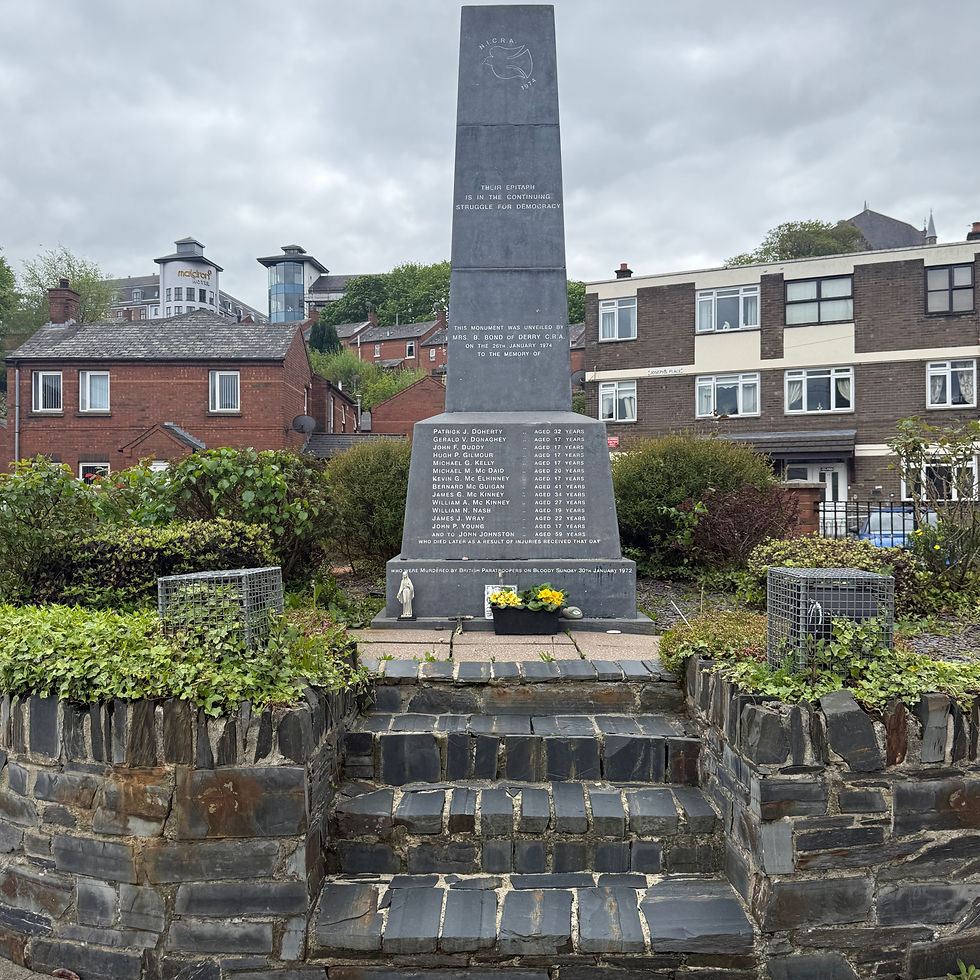
Memorial for the victims of Bloody Sunday.
After viewing the memorial I visited the museum, which was amazing, and includes a very thorough retelling of the complex issues of the conflict leading up to the murders, and preserves many of the artifacts, images, and footage of the event itself.
I walked through Derry and saw several of the murals, including the one for the Derry Girls (a hilarious TV show set in the 1990s in Derry - on Netflix, it’s the best).
Murals for The Troubles and Bloody Sunday around Free Derry.

Such a great TV show…
Then I headed back to the car, and drove the 10 minutes back out of the UK into the Irish countryside to my lovely little hotel, An Grianán. I got checked into my massive room and made a dinner reservation for 6 pm, since this place is both very close to Derry and not at all conveniently close to anything else.
Now, I didn’t finish telling my story about Northern Ireland, because Bloody Sunday is just one small part of an extremely bloody conflict spanning decades. If the police and British military could be said to be siding/supporting the Protestant community in Northern Ireland, some members of the Catholic community felt the need for armed support as well, and that took the form of an iteration of the Irish Republican Army, usually shortened to just the ‘IRA’. And I won’t mince words about this (because I will also say that the British military absolutely committed murder on Bloody Sunday) but the IRA was and still is a horrific terrorist group.
The IRA waged a terrorist campaign in Northern Ireland (and in one instance, London) that destroyed property, disrupted lives, disappeared and murdered innocent civilians, and committed general violence all with the goal of freeing Northern Ireland from British rule, by any means necessary. I HIGHLY recommend the book Say Nothing along with the Hulu series of the same name, which tells true stories about many of the atrocities committed by the IRA told by the members themselves. It’s harrowing, but you also understand who the participants were and why they thought they had to commit these horrific acts.
There are many other stories from the conflict, including those of Catholic priests working to bring the two sides together for peace, that give you hope, but since I am going to be spending a couple of days in Northern Ireland I wanted to make sure I acknowledged the (very recent) violent past of the region as well. If you want an uplifting story, I highly recommend the movie Belfast, which is lovely and tells the story of the conflict from the perspective of a Protestant family in Belfast.
To end the night on a better note, I headed to the restaurant at 6 and had the most amazing meal of this entire trip, a roast beef and mashed potatoes monstrosity that was delicious. Tomorrow I’m heading to Belfast, with several stops along the way, so hopefully a more chill driving day.


Comments